Why This Book Grabs Attention So Fast
Disclosure: As an Amazon Associate, I earn from qualifying purchases.
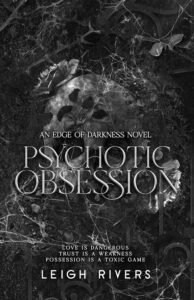
Some books pull readers in with a sweet premise. Others pull you in with danger signals — and Psychotic Obsession by Leigh Rivers clearly belongs to the second group. The title itself is a warning label and an invitation at the same time. If you browse dark romance, psychological romance, or morally gray relationship stories, this book practically jumps off the list.
Readers usually pick up Psychotic Obsession when they want emotional intensity instead of comfort, when they want relationship dynamics that feel unstable and risky rather than safe and predictable. It’s not marketed as gentle love — it’s marketed as consuming fixation — and that honesty about tone is one of its strengths.
This is the kind of book you start because you’re curious how far emotional obsession can go when the author doesn’t try to soften it.
The Emotional Atmosphere & Psychological Pressure
The emotional atmosphere in Psychotic Obsession by Leigh Rivers feels tight and pressurized, almost like being in a closed room where emotions keep building with no release valve. Instead of relying on constant external drama, the story builds internal psychological pressure between characters.
There’s a steady sense of emotional proximity — people paying too much attention, noticing too many details, reacting too strongly to small shifts. That creates tension even in quieter scenes. You don’t need explosions when emotional focus is this sharp.
What makes the book stand out is that attraction and discomfort exist side by side almost the entire time. You’re meant to feel pulled in and slightly uneasy at once. The romantic tension doesn’t feel soft — it feels charged. That gives Psychotic Obsession a psychological edge that separates it from standard dark romance stories that rely mostly on dominance tropes.
The mood stays serious throughout. There’s very little emotional relief humor or tonal reset. Some readers will love that consistency because it keeps immersion strong. Others may find it emotionally heavy — but that heaviness is clearly intentional.
How the Author Builds Tension Without Big Plot Tricks
A lot of romance suspense relies on plot twists, secrets, or external threats. Psychotic Obsession by Leigh Rivers uses a different engine: emotional anticipation. Tension comes from wondering how someone will react, not what will happen next.
Leigh Rivers builds tension through three main techniques:
-
Close internal perspective — we sit inside emotional reactions
-
Loaded conversations — dialogue carries hidden motives
-
Behavioral patterns — repeated attention and fixation signals
Because of this, scenes that look simple on paper often feel intense while reading. A conversation across a table can feel more suspenseful than an action scene because emotional stakes are high.
The author also uses emotional escalation instead of plot escalation. Feelings grow sharper, reactions grow bigger, interpretations grow more extreme. That gradual psychological climb makes the story feel cohesive rather than twist-dependent.
In Psychotic Obsession, tension feels like a tightening knot, not a series of shocks.
Relationship Dynamics — Control, Vulnerability, and Power Shifts
The relationship structure in Psychotic Obsession by Leigh Rivers is built on imbalance — but not in a one-note way. Power shifts frequently, and that’s what keeps the dynamic interesting.
Control in this story is not only physical or social — it’s emotional and informational. Who knows what? Who understands whose feelings? Who reveals vulnerability first? Those questions shape the emotional battlefield between the leads.
What I found especially effective is that emotional exposure is treated like risk. When a character reveals fear or desire, it changes the power balance. That makes emotional honesty feel dangerous, which fits the obsession theme perfectly.
The connection between the leads grows through friction, not harmony. They don’t smoothly align — they collide, reassess, and circle each other emotionally. That makes the relationship feel volatile but alive.
Psychotic Obsession doesn’t present love as healing first — it presents it as destabilizing first. That’s a bold but fitting choice for the subgenre.
Psychological Triggers and Behavior Patterns in the Story
One of the more interesting aspects of Psychotic Obsession by Leigh Rivers is how obsession is shown through repeated behavior rather than dramatic gestures. It’s not just big moments — it’s patterns.
You see fixation through attention habits, emotional monitoring, reaction intensity, and interpretive bias. Characters read too much into small signals. They assign meaning quickly. They hold onto emotional details longer than they should.
This pattern-based portrayal makes the obsession feel psychologically grounded instead of theatrical. It mirrors real unhealthy attachment styles more closely than exaggerated fictional stalking tropes.
The book also shows how obsession feeds on uncertainty. The less emotionally secure the situation becomes, the stronger the fixation grows. That feedback loop is portrayed well and gives the emotional arc credibility.
Another psychological layer in Psychotic Obsession is emotional justification. Characters don’t see themselves as irrational — they build internal arguments for their behavior. That self-justification adds realism and depth.
Most Memorable Element of the Reading Experience
The most memorable element of Psychotic Obsession by Leigh Rivers is the emotional unpredictability in character reactions. Not random — but intense enough that you can’t fully predict the response curve.
There are several moments where emotional expectations get flipped — where a character reacts more calmly than expected or more strongly than expected — and those moments land with real impact. They feel human, not scripted.
Another standout feature is confrontation dialogue. The author writes emotionally loaded exchanges very well. Lines often carry layered meaning — what’s spoken versus what’s implied versus what’s felt. That gives key scenes replay value in your head after you read them.
I also found the emotional discomfort memorable. The book doesn’t rush to reassure the reader. It allows awkwardness and emotional wrong steps to sit on the page. That takes confidence in tone, and it works here.
When Psychotic Obsession hits its peak moments, they stick.
Where the Story Could Have Been Stronger
Even strong dark romance benefits from contrast, and this is where Psychotic Obsession by Leigh Rivers could improve slightly. The emotional intensity is so consistent that it sometimes lacks variation. When nearly every major scene carries high emotional charge, the peaks blend together a bit.
A few emotionally neutral or quietly reflective scenes would have increased contrast and made the explosive moments feel even more powerful.
I also think some secondary relationship threads could have been developed further. A wider emotional ecosystem around the main characters would make the psychological stakes feel more socially grounded.
Another minor issue is that a few emotional realizations happen quickly inside characters’ thoughts without enough visible behavioral buildup. The feelings make sense — but showing more external triggers would strengthen those transitions.
These are tuning issues, not structural failures — but worth noting honestly.
Ideal Reader Profile — And Who Might Struggle With It 😎
Psychotic Obsession by Leigh Rivers is a strong fit for readers who enjoy dark psychological romance where emotional instability is part of the appeal, not a side effect. If you like character-driven tension and morally complicated attraction, this book will likely work for you.
Best suited for readers who enjoy:
-
Dark romance with psychological depth
-
Emotionally volatile relationships
-
Obsession and fixation themes
-
High emotional tension over high plot twists
Readers who may struggle with Psychotic Obsession include those who prefer emotionally healthy relationship models, lighter tones, or comforting romance arcs. If you want emotional safety and mutual stability in your love stories, this book will probably feel stressful rather than enjoyable.
It’s also not ideal for readers who need fast-moving external plot. This story moves through feelings more than events.
Closing Thoughts — A Dark Romance That Commits to Its Premise
Psychotic Obsession by Leigh Rivers succeeds because it fully commits to its psychological premise. It doesn’t decorate obsession — it examines it. The emotional tension is steady, the character psychology is layered, and the relationship dynamic feels volatile in a believable way.
The writing favors emotional immediacy over stylistic flourish, which suits the story. Dialogue is sharp, internal reactions feel raw, and emotional stakes stay high. While the book could benefit from more tonal contrast and slightly broader side-character development, the central psychological tension carries the experience strongly.
This is not a comfort read and never pretends to be. It’s emotionally sharp, sometimes uncomfortable, and intentionally intense. For readers who want dark romance with real psychological bite, Psychotic Obsession by Leigh Rivers delivers a gripping and memorable ride.