
Atomic Habits Book Review: How Small Changes Create Remarkable Results
Disclosure: This post contains affiliate links. If you purchase through these links, I may earn a small commission at no extra cost to you.
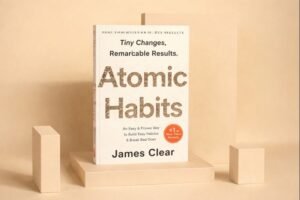
In a world obsessed with overnight success, Atomic Habits by James Clear delivers a refreshing and realistic message: meaningful change doesn’t happen all at once—it happens little by little. Published in 2018, this book has become one of the most influential self-improvement books of the last decade, and for good reason.
Rather than relying on hype or empty motivation, Atomic Habits focuses on practical systems, behavior science, and real-life examples. It teaches readers how tiny habits, repeated consistently, can lead to extraordinary personal and professional growth.
This review explores what Atomic Habits is about, why it resonates so strongly with American readers, and whether it’s worth your time.
What Is Atomic Habits About?
At its core, Atomic Habits is a book about behavior change. James Clear argues that success is not the result of big goals or dramatic transformations but the outcome of small, consistent improvements.
The word atomic is used in two ways:
-
Something extremely small
-
Something extremely powerful
Clear combines these meanings to explain how tiny habits—when compounded over time—can completely reshape your life.
Whether you want to:
-
Improve your health
-
Advance your career
-
Build better relationships
-
Become more productive
This book offers a framework that can be applied to almost any area of life.
Why Atomic Habits Became So Popular in the U.S.
The American audience tends to value efficiency, self-reliance, and personal growth, and Atomic Habits fits perfectly into that mindset. Instead of telling readers to “dream big” or “push harder,” James Clear emphasizes systems over willpower.
One of the book’s most quoted ideas is:
“You do not rise to the level of your goals. You fall to the level of your systems.”
This resonates deeply with professionals, entrepreneurs, students, and athletes across the United States—people who are tired of setting goals that never stick.
Goals vs. Systems: A Powerful Shift in Thinking
Most self-help books focus heavily on goal-setting. Clear challenges this approach.
Goals are about results.
Systems are about process.
Two people can have the same goal—say, losing 20 pounds—but the person with better daily habits will succeed. Atomic Habits teaches that if you fix the system, the results will take care of themselves.
This shift in mindset alone makes the book worth reading.
The Four Laws of Behavior Change
The foundation of Atomic Habits is built on four simple but powerful rules that explain how habits are formed and broken.
1. Make It Obvious
Habits don’t start with motivation—they start with awareness.
Clear introduces the idea of habit tracking and environment design. If you want to build a habit, you must first make it visible.
Example:
-
Want to read more? Leave a book on your pillow.
-
Want to drink more water? Keep a bottle on your desk.
American readers especially appreciate this concept because it aligns with productivity culture and workplace optimization.
2. Make It Attractive
We’re more likely to repeat behaviors that feel rewarding.
James Clear explains how habits are deeply connected to dopamine and anticipation. To build a habit, you must associate it with something enjoyable.
Example:
-
Only listen to your favorite podcast while working out.
-
Pair boring tasks with music or small rewards.
This principle works exceptionally well in modern American lifestyles, where habits compete with constant digital distractions.
3. Make It Easy
One of the book’s most practical lessons is this: reduce friction.
If a habit is hard to start, you won’t stick with it. Clear suggests focusing on the two-minute rule—start a habit that takes less than two minutes.
Examples:
-
Don’t aim to “read every night”—start with one page.
-
Don’t aim to “work out for an hour”—just put on your gym shoes.
This approach removes pressure and builds consistency, something many Americans struggle with in fast-paced routines.
4. Make It Satisfying
Immediate rewards reinforce behavior.
Good habits often have delayed benefits, while bad habits provide instant pleasure. Atomic Habits teaches how to reverse this by making good habits feel satisfying right away.
Simple techniques like habit tracking, visual progress, or small celebrations help lock habits into place.
Identity-Based Habits: The Most Powerful Idea in the Book
Perhaps the most impactful concept in Atomic Habits is identity-based habits.
Instead of asking:
-
“What do I want to achieve?”
Clear suggests asking:
-
“Who do I want to become?”
This subtle shift changes everything.
Examples:
-
Don’t try to run a marathon → become a runner
-
Don’t try to write a book → become a writer
-
Don’t try to save money → become a financially responsible person
For American readers, this aligns strongly with the cultural emphasis on identity, self-branding, and personal values.
Writing Style and Readability
James Clear’s writing style is one of the book’s biggest strengths.
-
Clear, concise, and engaging
-
Backed by research but easy to understand
-
Filled with relatable stories and real-world examples
The book avoids academic jargon and reads more like a conversation than a lecture. This makes it accessible to a wide audience—from college students to CEOs.
Real-Life Applications of Atomic Habits
One reason Atomic Habits stands out is its practical applicability.
Readers commonly report improvements in:
-
Time management
-
Fitness and nutrition
-
Career discipline
-
Mental health routines
-
Financial habits
The strategies don’t require expensive tools, extreme discipline, or drastic lifestyle changes—just consistency.
Who Should Read Atomic Habits?
This book is ideal for:
-
Professionals feeling stuck or burned out
-
Entrepreneurs building long-term success
-
Students struggling with consistency
-
Anyone who has failed at New Year’s resolutions
If you’ve ever said, “I know what I should do, but I don’t do it,” this book is for you.
Pros and Cons of Atomic Habits
Pros
-
Practical and actionable advice
-
Backed by behavioral science
-
Easy to read and well-structured
-
Works for many areas of life
Cons
-
Some ideas may feel familiar if you’ve read many self-help books
-
Requires patience—no instant transformation
However, these “cons” are minor and don’t reduce the book’s overall value.
Final Verdict: Is Atomic Habits Worth Reading?
Absolutely.
Atomic Habits isn’t about motivation—it’s about mastery of the small things. It teaches readers how to work with human nature instead of fighting it.
For American readers navigating busy schedules, high expectations, and constant distractions, this book offers a sustainable way to improve without burnout.
If you’re looking for a self-help book that actually works in real life, Atomic Habits deserves a permanent place on your bookshelf.