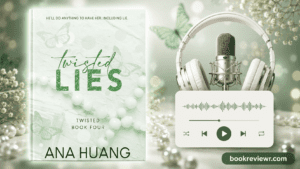
There are romance novels that entertain, and then there are ones that burrow under your skin and refuse to leave. Twisted Lies by Ana Huang firmly belongs in that second category. From its very first page, this book signals that it isn’t interested in playing it safe. It wants you unsettled, intrigued, and completely hooked — and it largely succeeds on all three counts.
As the fourth and final installment in the Twisted series, Twisted Lies carries the weight of reader expectations. Fans who followed the series wanted the best sendoff possible. What Ana Huang delivers is arguably her most emotionally complex story yet — one where the romance is equal parts swoon-worthy and morally murky. That tension is exactly what makes it so compelling to read.
Ana Huang is a Chinese-American author who rocketed to prominence through her self-published romance novels. Known for crafting morally grey heroes and emotionally layered heroines, she has built a devoted readership across the globe. The Twisted series — beginning with Twisted Love — cemented her reputation as one of the most compelling voices in contemporary dark romance.
What distinguishes Huang from many of her contemporaries is her ability to blend commercial readability with genuine emotional depth. Her heroes aren’t simply brooding for aesthetic reasons; they carry wounds that feel earned. Her stories are fast-paced yet take time to breathe when it matters most.
The Twisted Lies summary centers on Stella Alonso, a lifestyle influencer who lives behind a carefully curated online persona, and Christian Harper — a ruthless, obsessive businessman who operates in shadows most people are wise enough to avoid. When Stella needs protection from a stalker, Christian offers a deal that’s as dangerous as the threat she’s trying to escape.
Their arrangement is built on mutual need, laced with distrust, and crackling with tension. Christian watches Stella — not just to protect her, but because he wants to in ways that blur every line between guardian and possessor. What unfolds is a slow-burn romance wrapped in secrets, power plays, and a vulnerability that neither character wants to admit they feel.
The Twisted Lies themes go deeper than a typical romance plot. At its core, this is a book about the masks we build to survive — and what happens when someone refuses to let you hide behind yours. Both Stella and Christian are performers in different ways. She projects warmth and accessibility to her followers; he projects cold indifference to the world. Their relationship is the slow, painful process of unmasking.
There’s also a pointed commentary on social media culture woven through Stella’s storyline. The gap between who she shows online and who she actually is isn’t treated as shallow vanity — it’s portrayed as a coping mechanism, which gives the novel real texture. The Twisted Lies analysis wouldn’t be complete without noting how well Huang handles this particular theme, which could have easily tipped into caricature.
Ana Huang writes with confidence and commercial instinct. Her prose isn’t literary in the traditional sense — it’s propulsive. Sentences move quickly, dialogue crackles, and she knows exactly when to slow down for emotional impact. The alternating POVs between Christian and Stella work particularly well here; getting inside Christian’s head is both unsettling and essential for understanding why readers find him compelling rather than simply frightening.
Pacing is one of the novel’s quiet strengths. The first half builds tension with admirable patience. Some readers may find it slow, but those who surrender to the rhythm will find that the payoff — emotional and romantic alike — hits considerably harder because of it. The final act doesn’t rush its resolutions, which is a choice that takes confidence in an era of impatient reads.
The Twisted Lies analysis reveals a story that understands its genre deeply and then tries to do something more. It doesn’t pretend that an obsessive hero is unproblematic; it asks readers to sit with the discomfort, to examine why we’re drawn to these dynamics in fiction. That self-awareness, subtle as it is, elevates the book above many of its genre contemporaries.
Christian Harper, in particular, is a character study that lingers. He isn’t softened for palatability. His eventual vulnerability doesn’t erase his earlier behaviour; it contextualises it. That nuance is rarer than it should be in romance fiction, and it’s the thing that will stay with most readers long after the last page.
If dark romance with psychological depth is your reading territory, Twisted Lies belongs on your shelf — full stop. It’s particularly well-suited for readers who appreciate heroes who challenge them rather than simply charm them. Fans of authors like Penelope Douglas, Rina Kent, or L.J. Shen will find themselves comfortable in Huang’s world.
Readers who are new to dark romance or who prefer entirely healthy relationship dynamics may want to approach with awareness. This is a book that leans into its genre’s most provocative conventions intentionally. Understanding that going in will dramatically shape the reading experience.